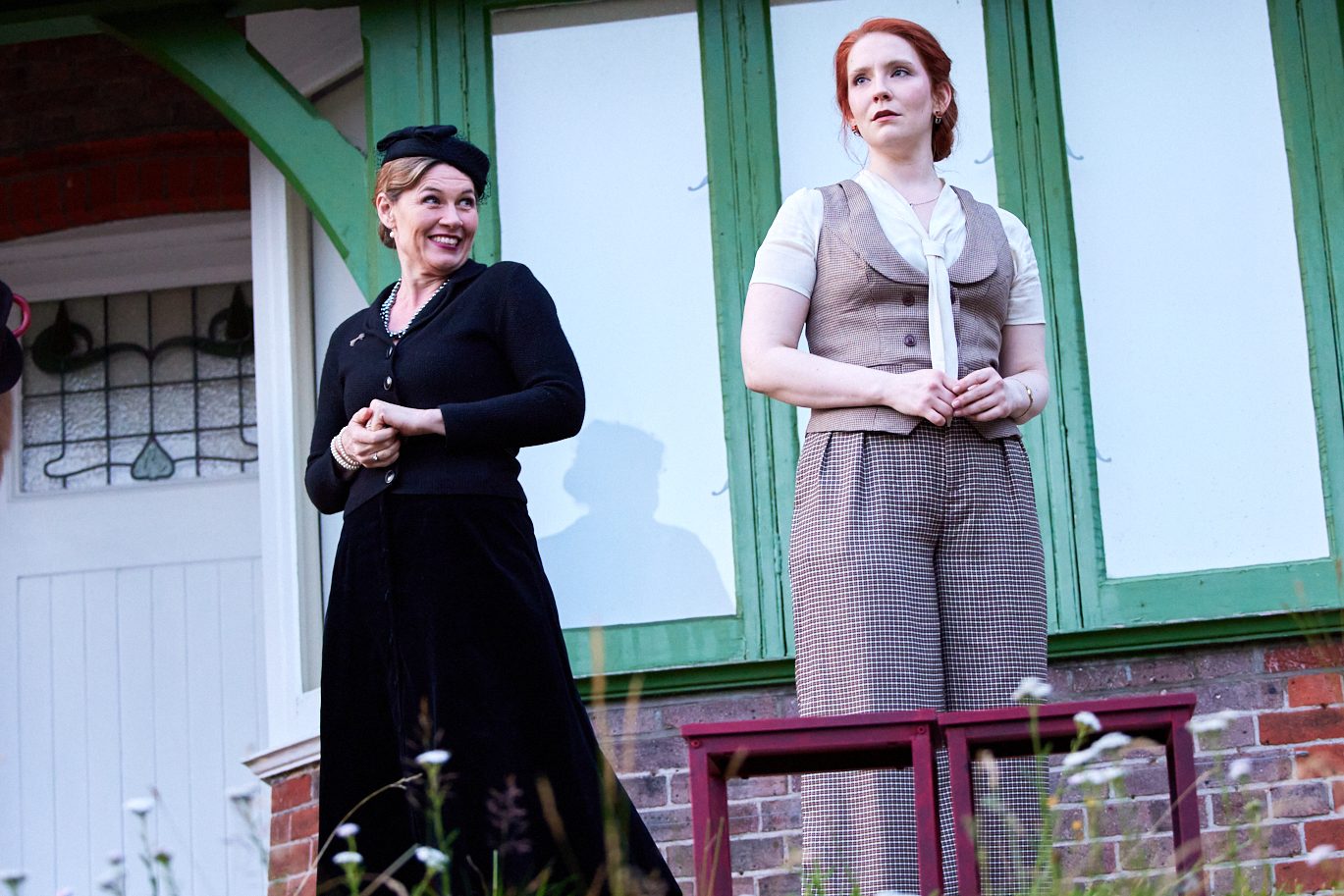
Rother Street Arts House, in association with Tread The Boards, will present Pygmalion by George Bernard Shaw, directed by Jonas Cemm.
The production is presented in partnership with SHAW2020, an award-winning theatre company that blends Shaw’s witty, thought-provoking texts with modern perspectives. Directing the piece, Jonas Cemm, Artistic Director of SHAW2020, draws on his extensive experience with Shaw’s work. A former trustee of the Shaw Society (an 84-year-old organisation dedicated to exploring the works and legacy of George Bernard Shaw) Cemm has a long-standing engagement with Shaw’s writing and a deep understanding of its humour, pace, and probing social questions…
Not all that glitters is on stage in the Edinburgh Fringe. This sparkling double bill directed by Jonas Cemm at The Tabard has wit and wisdom in plenty and provide Maryann O’Brien and Joe Sargent with opportunities to display their versatility playing two pairs of combative lovers while remaining looking pretty much the same. It is what one calls acting, and doing it very well indeed. The double bill consists of the 1933 A Village Wooing paired with The Proposal by Chekhov.
In The Proposal a young Russian landlowner turns up to ask for the hand in marriage of his neighbour’s daughter and his diffidence and her terrible temper repeatedly wrecks everything several times until they do get what they deserve – one another. It is fluff and treated as such.
A Village Wooing, however, is a more substantial piece and mines pretty much they same areas of men’s relationship with women as Man and Superman. A young woman who works in a village shop and looks after the telephone wins a prize and spends it by going on a cruise where she meets a stuffy widower who is writing a guidebook for the cruise company and finds her exasperating and unbearable. Some time later he is travelling in the country, visits a local grocer’s shop, and is persuaded that this is the perfect life for him but being the sort of man he is, he does not realise that the young woman who more or less runs it is the woman from the cruise ship. It makes for a very funny battle of the sexes as he may be unaware if who she is but she knows who he is and he is the man she has decided is the one she will marry….
London Pub Theatres – Heather Jeffery -14 August 2025
SHAW VS CHEKHOV is part of Theatre at the Tabard’s 40th Anniversary Season. An excellent choice for highlighting everything that the theatre stands for, with high production values using invention and innovation. Albeit a small-scale production the company, SHAW2020, present an excellent double bill of George Bernard Shaw’s VILLAGE WOOING and Anton Chekhov’s THE PROPOSAL. The two are paired together with the loose connection of women winning their man.
The ’fight’ kicks off with The Proposal, a comedy of manners and misunderstandings written in 1888. The set is a traditional Russian room, with wall hangings, period furniture with a beautiful samovar on one of the side tables. Enter elderly gentleman Stepan, looking for his flask of vodka which he has hidden somewhere behind the aspidistra. He is almost caught red handed, when his neighbour, the hypochondriac Ivan, comes to visit.
Ivan has come to propose to his daughter, Natalya. Stepan, is delighted, but when he leaves the man alone with his daughter the proposal is delayed by a series of misunderstandings caused by the pair raising disputes and forming jealousies. Directed by Jonas Cemm, in an updated translation by Bethany Blake, the piece is enlivened by the characterisations and the physicality. There is something of farce in the presentation with all three actors giving hugely detailed performances, a little larger than life. Something behind the sofa causes one of them to trip slightly and this is repeated in various guises throughout the play. Wonderfully timed and inventive, it works as a symbol of the state of each of the three characters. Will they ever complete the actual purpose of the visit, when they keep confounding each other?
The play is well modulated, leaving Chekhov’s clever dialogue, with its underlying satirical content, and caustic critique of the inability of neighbours to compromise, to shine. As a physician and writer first, Chekhov might well have observed that marriage sometimes holds similar horrors. Does Shaw think more highly of marital bliss?
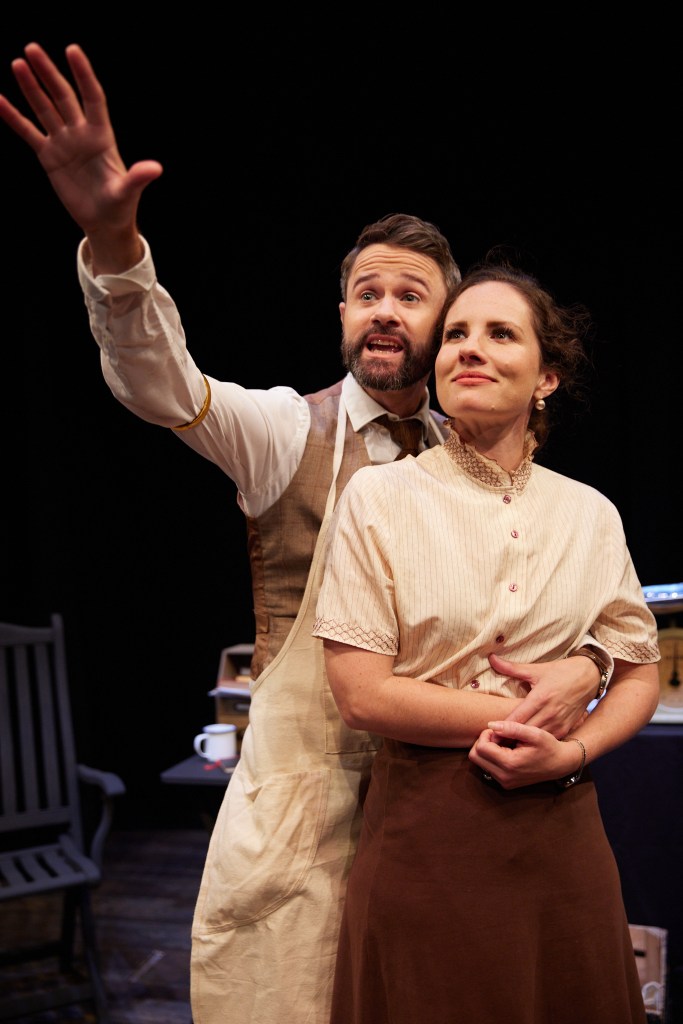
During the interval the stage manager dismantled the entire set and put up a new one. It was quite impressive, replacing the drawing room with the deck of a cruise ship. Later this same set becomes a grocer’s shop with a few added sticks of furniture and well-chosen props. The details include weighing scales and packets of old-fashioned sweets and goods and green grocer’s boxes full of vegetables. Once completed it’s almost possible to smell the shop, that slight fustiness, it creates such a complete vision of a way of life….
The Chiswick Calendar – August 11, 2025 by Simon Thomsett
The double header of one act plays at the Tabard, billed as Shaw vs Chekhov and running to 23rd August is a tasty and perhaps surprisingly frivolous delight.
First up is Chekhov’s The Proposal, a slight but enjoyable tale of a young man’s bumbled attempts to propose to a neighbour’s daughter.
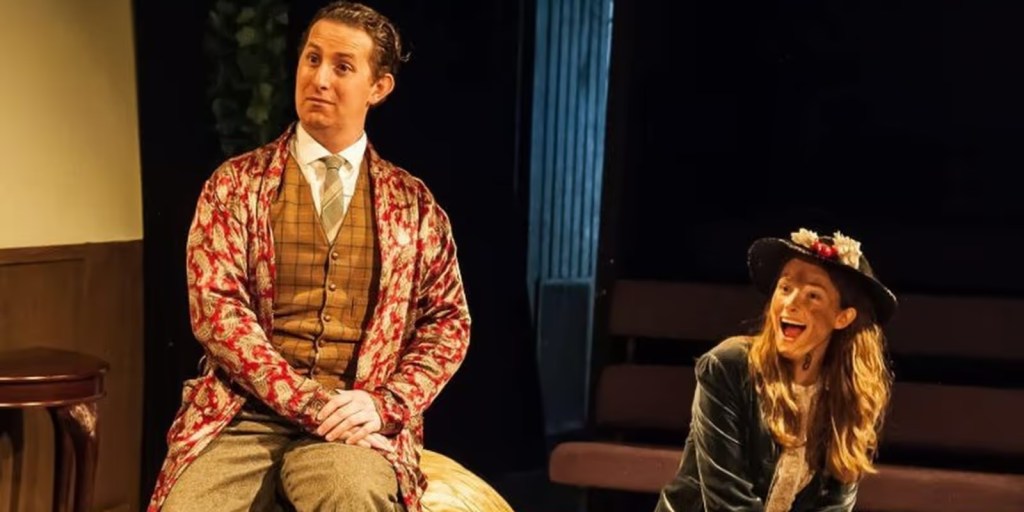
The young man, Ivan, played with nervy charm by Joe Sargent arrives for a meeting with Stepan to ask for his approval for the proposed union. Ivan has chosen to dress formally for the occasion, a choice Stepan mocks as looking as if he is on a “new year’s visit”.
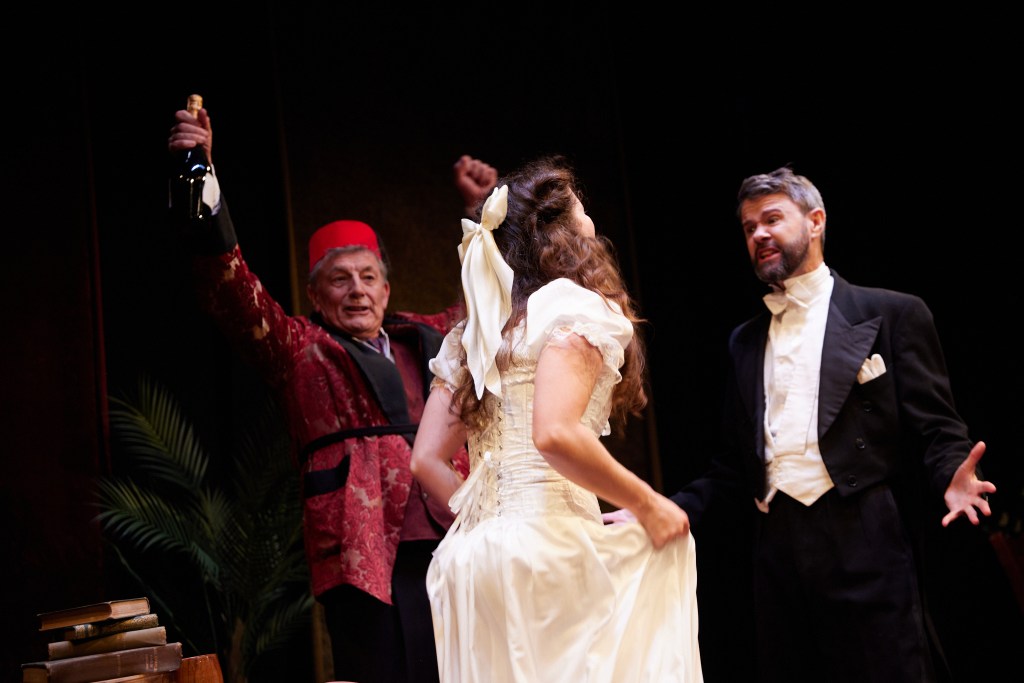
Anthony Wise as Stepan is ingratiating and campily welcoming; dressed in a sort of flock smoking jacket, topped off with a rather worn-out fez, he is given to furtive slugs from a hidden hip flask of vodka and to smothering his guest with unlikely endearments (“My pretty… my angel…”) and much hugging.
When he eventually lets him go, he sends for his daughter, who he suggests is waiting for such a moment as she is “like a love-sick cat”)
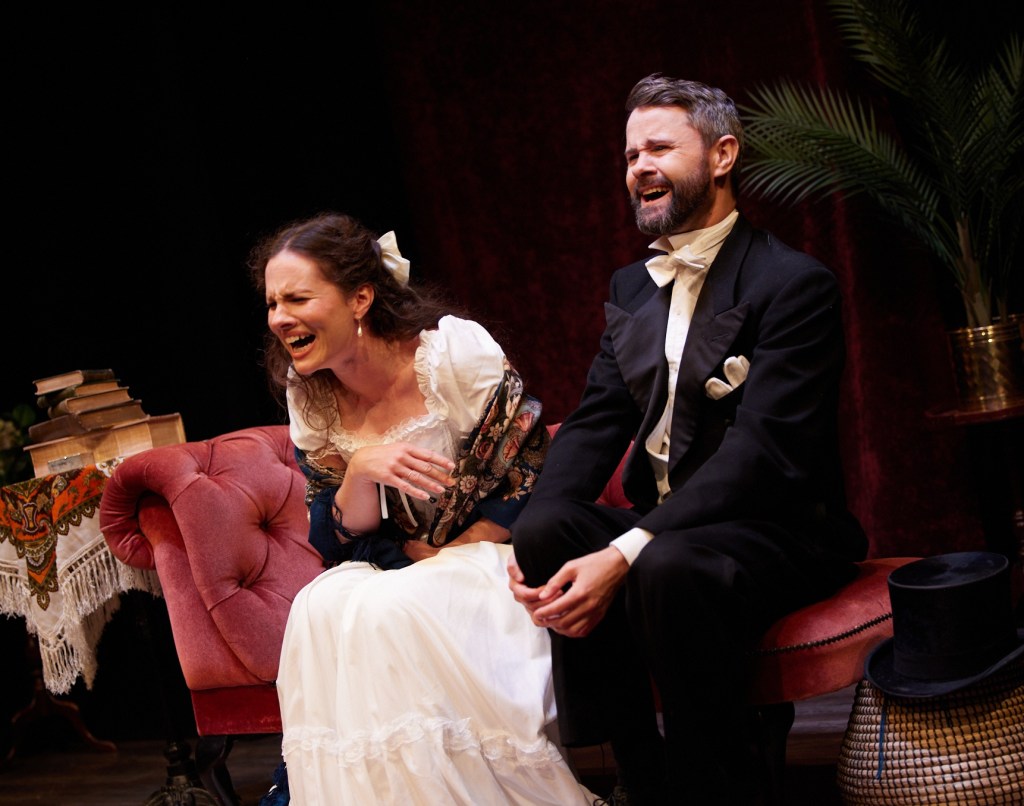
Maryann O’Brien as said daughter Natalya initially has no inkling of Ivan’s intentions and readily falls into an argument with him about the ownership of some adjoining land. Ivan makes some particularly inept attempts to put his proposal but is constantly derailed by falling into fundamentally silly arguments about very little.
O’Brien swings wildly from desperate would-be wife to furiously proud defender of petty principles. Matching her in neurotic energy, the stiffly tailcoated Sargent finds his body conspiring against him as a series of random but intense pain attacks threaten to overwhelm him at any moment.
There’s even some well executed slapstick and the whole thing plays out to a satisfying conclusion…
LondonTheatre1 by John OBrien / August 10, 2025 ★★★★
Finding new ways to present the classics is both challenging and necessary, so Shaw’s 2020 pairing of two one-act plays by two of the greatest dramatists of all time (Anton Chekhov and George Bernard Shaw) is most welcome. As soon as I saw this, I wanted to see it, and my hunch has proved correct. Jonas Cemm, the director of Shaw 2020, is dynamic, determined and dedicated to his project. Shaw died in 1950, and so in 2020, his copyright expired, hence the name. Cemm aims to keep Shaw’s legacy alive and kicking by adapting, expanding and exploring the works. His master stroke is to juxtapose a Shaw alongside another work by a peer competitor.
In this case, he has pitched Chekhov’s The Proposal (1888), updated by producer and designer Bethany Blake, and Shaw’s one-act comedy Village Wooing (1933), edited by Cemm himself in 2021. Both pieces are about partner selection. Just how do we get paired off? What drives it? Who initiates it? How do we know who “The One” is? How can we be sure? No pun intended. The USP of this double bill is that both pieces are funny, witty and yet highly philosophical in intent. The Proposal is up first, a short but perfectly formed 45 minutes, and then after the interval, the main attraction, I think, Village Wooing, about an hour….
“an engaging night of theatre” – The Spy In The Stalls – 8th August 2025 by Violet Howson
‘Shaw vs Chekhov’, directed by Jonas Cemm, forms the next instalment of theatre company SHAW2020’s ‘Shaw Versus’ series, in which George Bernard Shaw’s work is performed in conjunction with a play written by a contemporary. In this case: Anton Chekhov’s ‘The Proposal’ is paired with Shaw’s ‘Village Wooing’. It’s a charming double-billing, but also a good reminder that not everything a great writer writes is necessarily great.
First up was ‘The Proposal’, a thirty-minute play in which Joe Sargent’s Ivan intends to propose to Maryann O’Brien’s Natalya, but spends the duration of his time bent over in a bizarre mish mash of pains and heart palpitations, all the while bickering consistently with his nuptial victim-to-be. Lavish costumes and impressive set complemented accomplished performances, especially from O’Brien who remained strong throughout. Chekhov’s ‘Proposal’ is probably never going to rival his ‘Three Sisters’, but it still maintained glimmers of his characteristic charm. Anthony Wise as Natalya’s befuddled father Stepan was also adorable. The latter piece in this double-bill was Shaw’s ‘Village Wooing’, a two-hander less hampered by heart palpitations. Village Wooing follows a pompous writer of well-known travel guides, and his enemy-to-lover assailant, who insists upon conversing with him, to his understandable aggravation. Upon a pleasure ship together, they enter a reluctant but gradually warm conversation, then part for soup, only to be reunited in the village shop in which O’Brien’s character works. By some inexplicable course, said pompous man ends up running the shop and romance follows closely behind….
A ONE-OFF performance of one of George Bernard Shaw’s classic plays will be staged in July to mark the playwright’s birthday.
SHAW2020’s production of Village Wooing will run at the Irish Cultural Centre (ICC) in Hammersmith on July 27, just one day after what would have been Shaw’s 169th birthday.
Born in Dublin on July 26, 1856, Shaw remains one of Ireland’s most celebrated literary figures.
The ICC organisers say their commemorative event is set to “honour his enduring legacy with a witty, incisive piece that showcases the playwright’s hallmark charm, intellect, and social critique”. Directed by Jonas Cemm, and former trustee of The Shaw Society, the production of Shaw’s anti-romance play stars Joe Sargent as ‘A’, a reserved guidebook writer, and Maryann O’Brien as ‘Z’, a quick-witted country shopgirl determined to draw him out of his shell.
“We are so looking forward to hosting the production of Village Wooing here at the ICC, as we know that SHAW2020 produce Bernard Shaw productions of the very best,” Rosalind Scanlon, Cultural Director of the Irish Cultural Centre, said this week….
Offering a fresh take on George Bernard Shaw’s pertinent play, Mrs. Warren’s Profession, SHAW2020 presented an adaptation that bears striking relevance in today’s social landscape. Famed for being banned by the Lord Chamberlain due to its narrative thread of prostitution, Mrs Warren’s Profession critiques the social and economic systems that force women into exploitative situations. Through sharp direction and evocative performances, the production underscores the timeless themes of societal hypocrisy and personal autonomy.
Joe Sargent as Frank and Bethany Blake as Vivie
This design collaboration between director/actor Jonas Cemm, actor/producer Bethany Blake and costume consultant Ruth Hepplethwaite takes us on a journey of discovery of their stylistic choices. Costumes deepening the audience’s understanding of the characters’ complexities and the era’s constraints. The play opens with Vivie Warren, a twenty-something year-old woman wearing wide-leg trousers, attire that instantly attests to the fact that the 1893 play’s timeline has been reset in the 1930s. This era marked a significant shift in both fashion and societal norms, and saw an increasing number of women challenging traditional gender roles by breaking down rigid sartorial conventions. Vivie Warren is a character who bucks tradition, having recently earned distinction in mathematics at Cambridge college. As well as highlighting her modern attitude, her wearing of trousers signals the broader social changes of the time.
Anthony Wise as SamJonas Cemm as CroftsKarl Moffatt as PreadJoe Sargent as Frank
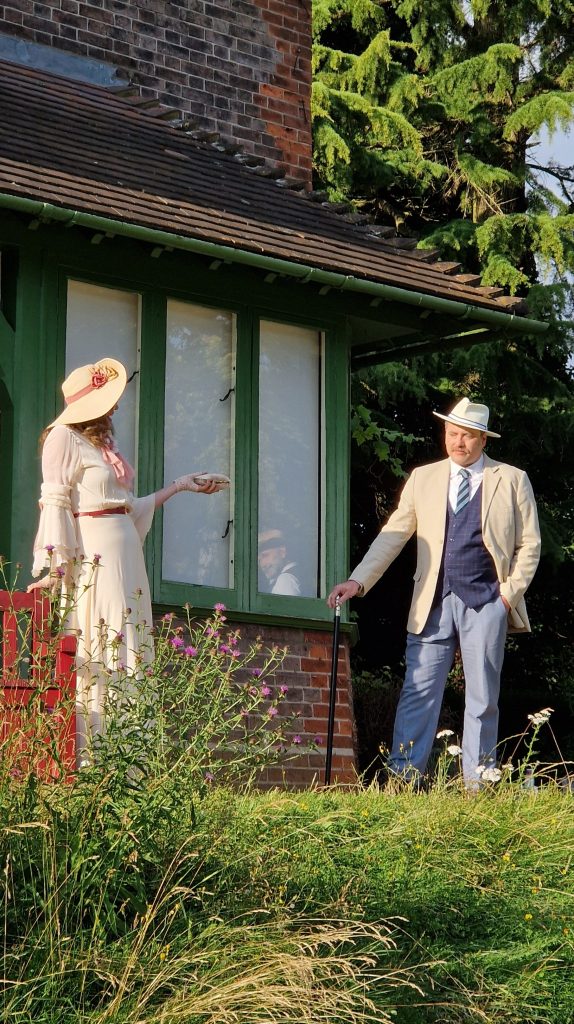
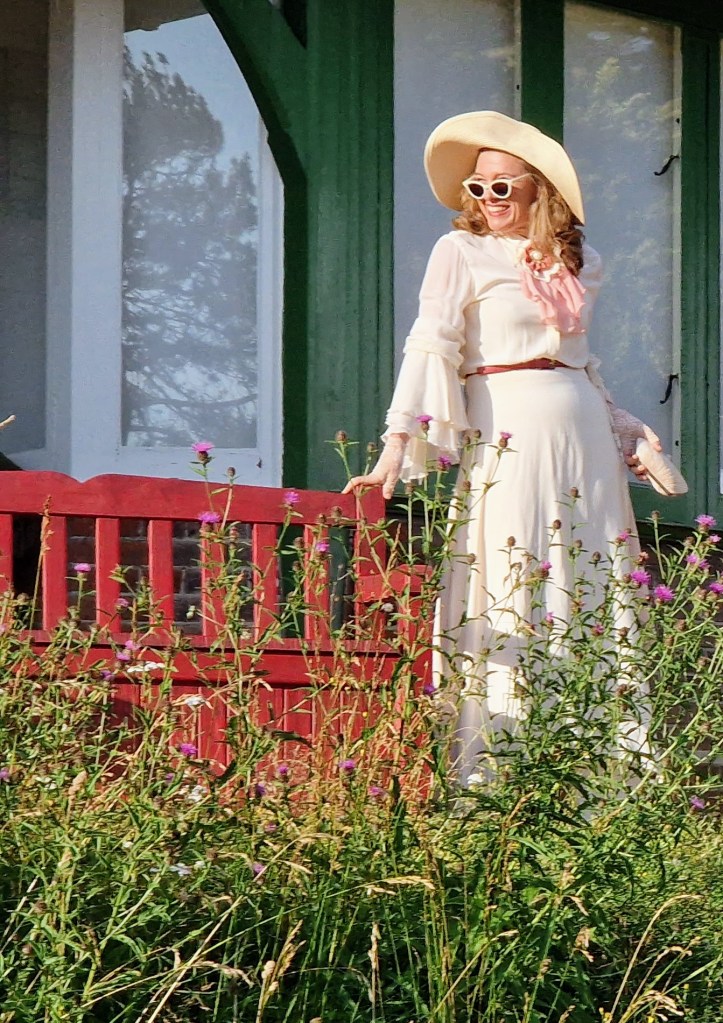
Vivie’s mother, Mrs. Kitty Warren, dramatically enters the scene in a wide-brim straw hat and sunglasses, evoking the air of a Hollywood star. Bedecked in a cream-hued chiffon gown complete with vertiginously tiered angel sleeves, a pink ruffled rosette and lace fingerless gloves, Kitty’s opening costume is intentionally over-the-top and stands in stark contrast to her daughter’s attire. The fluid lines, light tones and ruffled elements all converge to create the illusion of a glamorous, successful woman. Although both women preside over their male companions in this opening scene, Kitty asserts her dominance through an intentionally amplified femininity, whereas Vivie is presented as modern and independent.
Laura Fitzpatrick as Kitty and Jonas Cemm as CroftsLaura Fitzpatrick as Kitty
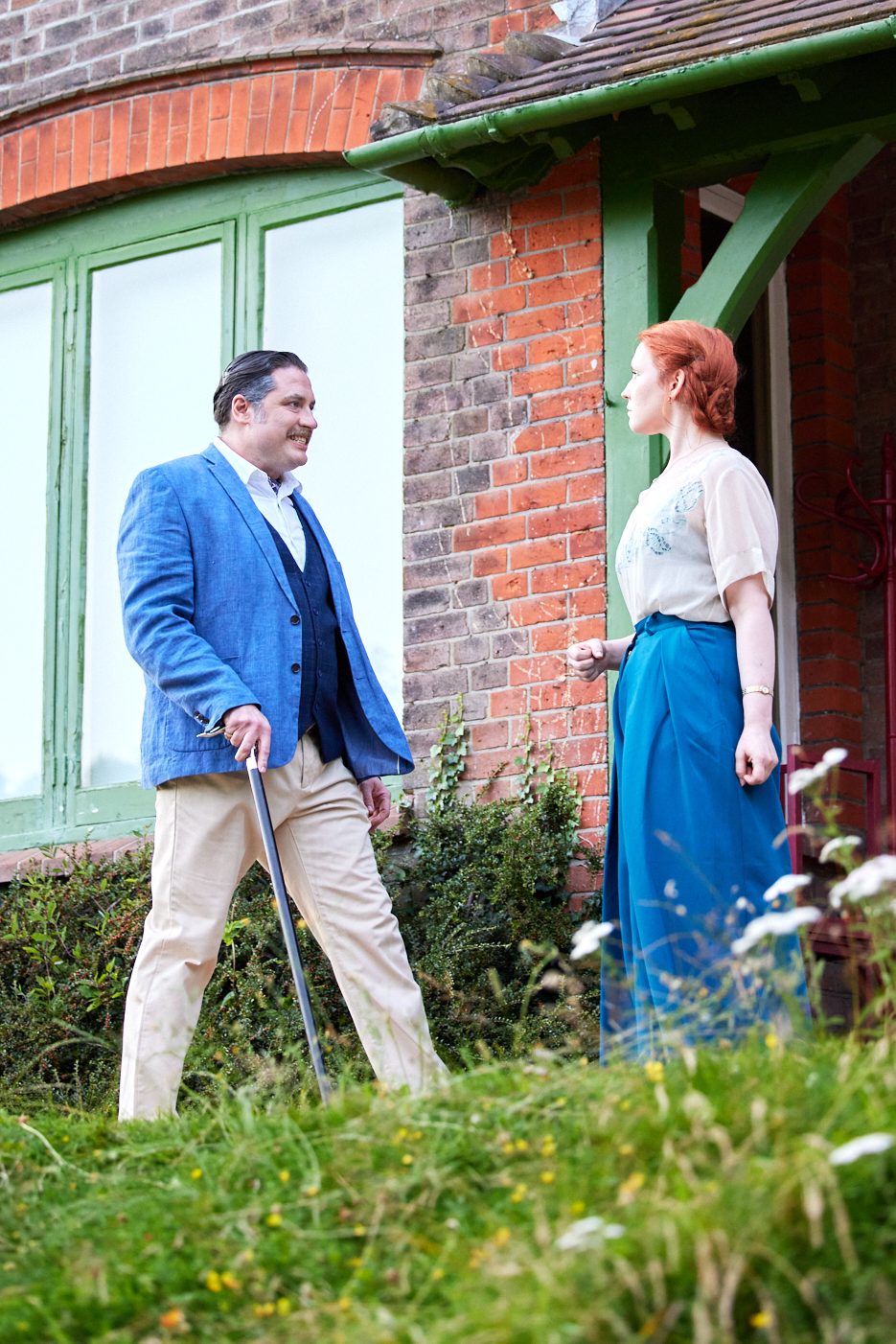
Accompanying Kitty in the opening scene is Sir George Crofts, who is introduced as her business partner. Wearing light summer linens and carrying a rather menacing silver-headed cane, his powerful yet morally questionable character is demonstrated from the offset. While Crofts’ wardrobe seems relatively uncomplicated, in that he is well dressed as an aristocratic gentleman, the artful link to the characters he interacts with is evident in the colours he wears. The neutral tones are complementary to Kitty’s cream gown, a sartorial reference to their flirtatious interactions and longevous partnership. By the next day, Crofts is wearing a cornflower-blue linen jacket in a similar hue to that of Vivie’s trousers. The coordination between the two is a visual attestation of Crofts’ perverted ‘attraction’ to Vivie, a young girl who, it is later revealed, could be his daughter.
Jonas Cemm as Crofts and Bethany Blake as Vivie
Frank Gardner is also romantically interested in Vivie, often engaging in flirtatious and playful conversation with her. However, Frank is financially irresponsible, relying on his father, Rev. Samuel Gardner’s allowance and seeking to marry Vivie largely for her presumed wealth. His boyish charm and frivolity is reflected in the bold colours he wears, as seen with his purple hat and vibrant orange socks. Again, stark contrasts between the costumes are created to indicate the characters’ opposing dispositions. Mr Praed, a close friend of Mrs. Warren, serves as a kind, cultured, and genteel figure, wearing artistic clothing spun from linen or tweed. When set side by side, Frank and Praed’s juxtaposing attire represents their different values.
Laura Fitzpatrick s Kitty and Karl Moffat as Pread
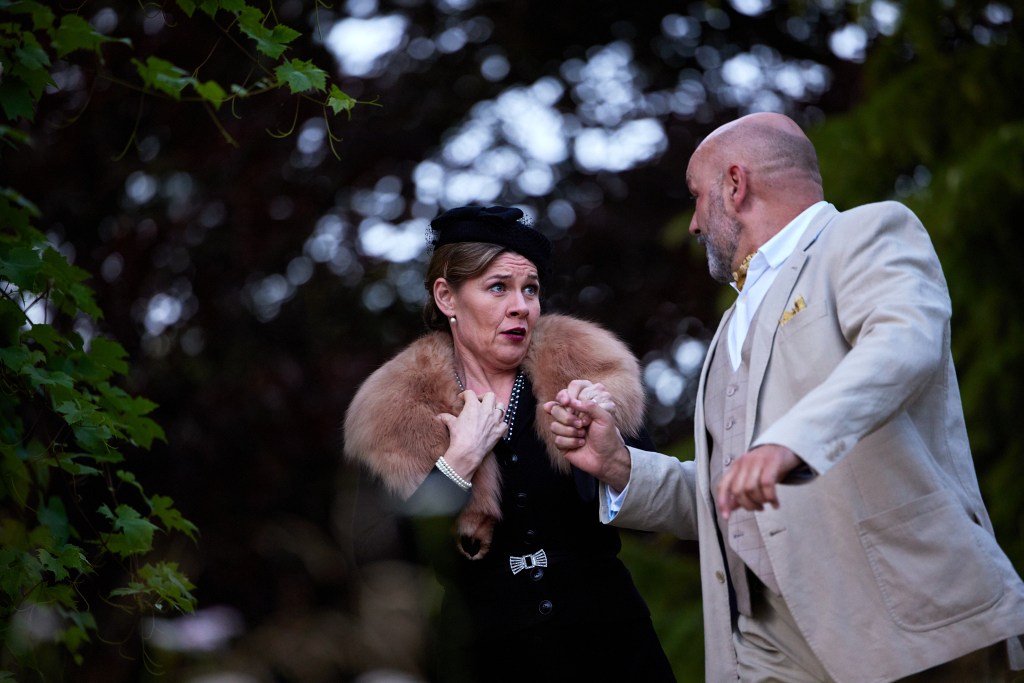
By the final scene, both women have their battle armour on. Having just learned the full extent of Kitty’s involvement in the brothel business, Vivie is visited at work by her mother. Vivie is wearing trousers and a matching waistcoat, spotlighting her status as a professional woman and her values of hard work, independence, and moral integrity. By contrast, Kitty is conservatively dressed in black, almost in mourning attire, a stark juxtaposition to her outfit in the opening scene. The play ends with Kitty heartbroken and alone as Vivie turns her back on her mother, choosing a life of hard work and self-reliance.
Laura Fitzpatrick as Kitty and Bethany Blake as Vivie
This adaptation was not only a compelling exploration of Shaw’s timeless themes but a visual journey through the evolution of each character. The costumes play a crucial role in this transformation, subtly mirroring the shifting dynamics between the characters and their own evolving narratives.
Rose Coffey – Senior Foresight Analyst: Fashion, Retail & Luxury
Much like his theatrical contemporaries Ibsen and Strindberg, George Bernard Shaw wasn’t afraid of challenging the audience and broaching serious subjects – especially the way money and class plays a big part in the dynamics between men and women. In Mrs Warren’s Profession (which is directed by Jonas Cemm), what starts as a comedy of sorts evolves into an in-depth exploration of the relationship between commerce, the ‘real’ choice available to women and whether ‘morality’ is a luxury for the destitute.
If you’re a fan of the work of George Bernard Shaw, then you’ll be pleased to hear about a production that will be gracing more than one London stage this summer. If you’re not a fan, I expect it’s because you haven’t yet been exposed to any of his myriad excellent plays, so it feels like a good time for you to take one in.
Coming to both Jack Studio Theatre and the Tabard Theatre this month is Shaw2020’s latest production, of ‘Mrs Warren’s Profession’, which was banned when first produced because of its controversial themes.
I wanted to find out more about this production, as well as the company behind it. So I spoke to Shaw2020’s Jonas Cemm, who directs and appears in this staging.